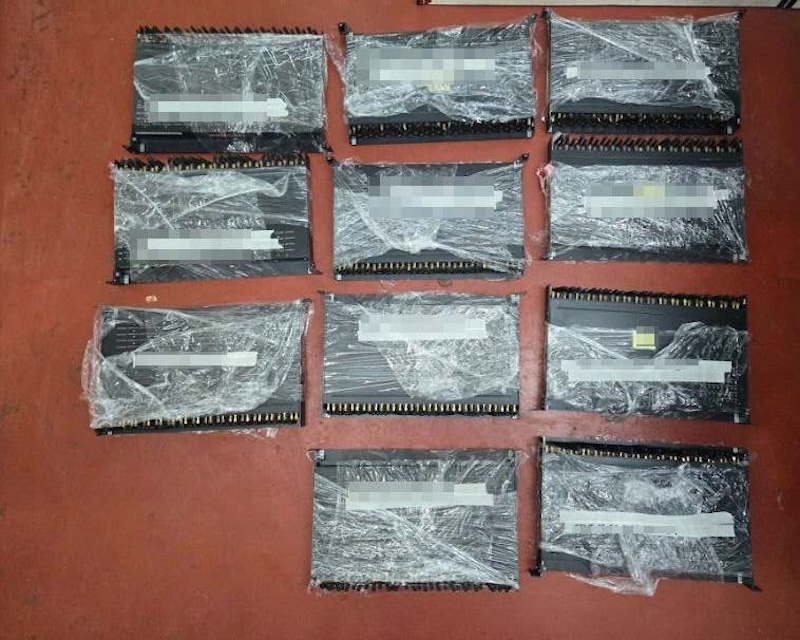
Officers of the Philippine National Police Anti-Cybercrime Group (PNP-ACG) have shared photographs of 11 simboxes confiscated following a recent sting. The police followed a similar approach to other operations they have conducted in recent months by masquerading as potential buyers of spam equipment advertised online. One man was arrested in the operation, which occurred in Taguig City on July 22. Taguig lies on the Eastern shores of Metro Manila.
The arrested man told police that the simboxes were part of a bundle of equipment he had obtained from a Philippine Offshore Gaming Operator (POGO) that went out of business. POGOs were legal in the Philippines but are being eradicated following a change in government. Those POGOs which continue to operate illegally are often associated with scam call center operations. They have been subjected to a series of high-profile police raids. Many foreigners are found working for the illegal POGOs. It is also common for the police to capture radio comms equipment from the POGOs they raid.
POGOs evolved as businesses that principally provided gambling opportunities to a Chinese clientele because gambling is prohibited on the Chinese mainland. Many POGOs had ties to Chinese businessmen. It was common for POGOs to use spam communications equipment like simboxes and SMS blasters to advertise their services. The relatively sudden closure of the POGOs has resulted in a flood of second-hand spam equipment being offered for sale.
Philippine police and other Philippine authorities have adopted an unfortunate habit of referring to any device which can be used to originate a large number of spam SMS messages as a ‘text blaster’, and that was also the case with the official announcements surrounding this particular arrest. Simboxes, also known as GSM gateways, are devices which act like high-volume mobile phones, instigating communications through a radio connection to a conventional mobile operator’s network. They should not be confused with fake base stations that have been designed to send large numbers of SMS messages directly to any mobile phone within range; in most countries these devices are commonly referred to as SMS blasters. It is obvious from photographs that this raid seized simboxes even though they were described as ‘text blasters’.
The police also shared an update about their anti-spam operations at the same press conference. Per their figures, they arrested 16 other people between December 20, 2024 and July 31, 2025 for attempting to sell simboxes and SMS blasters online.
The vigor with which the Philippine police is finding and confiscating spam comms equipment contrasts sharply with the lethargy shown by the authorities in many countries. Too few countries have adequate laws to restrict the sale and use of radio devices that are typically used for scam and spam communications. Even fewer dedicate police resources to enforcing those laws.
Photographs of the arrest and of the 11 simboxes seized in Taguig are reproduced below.